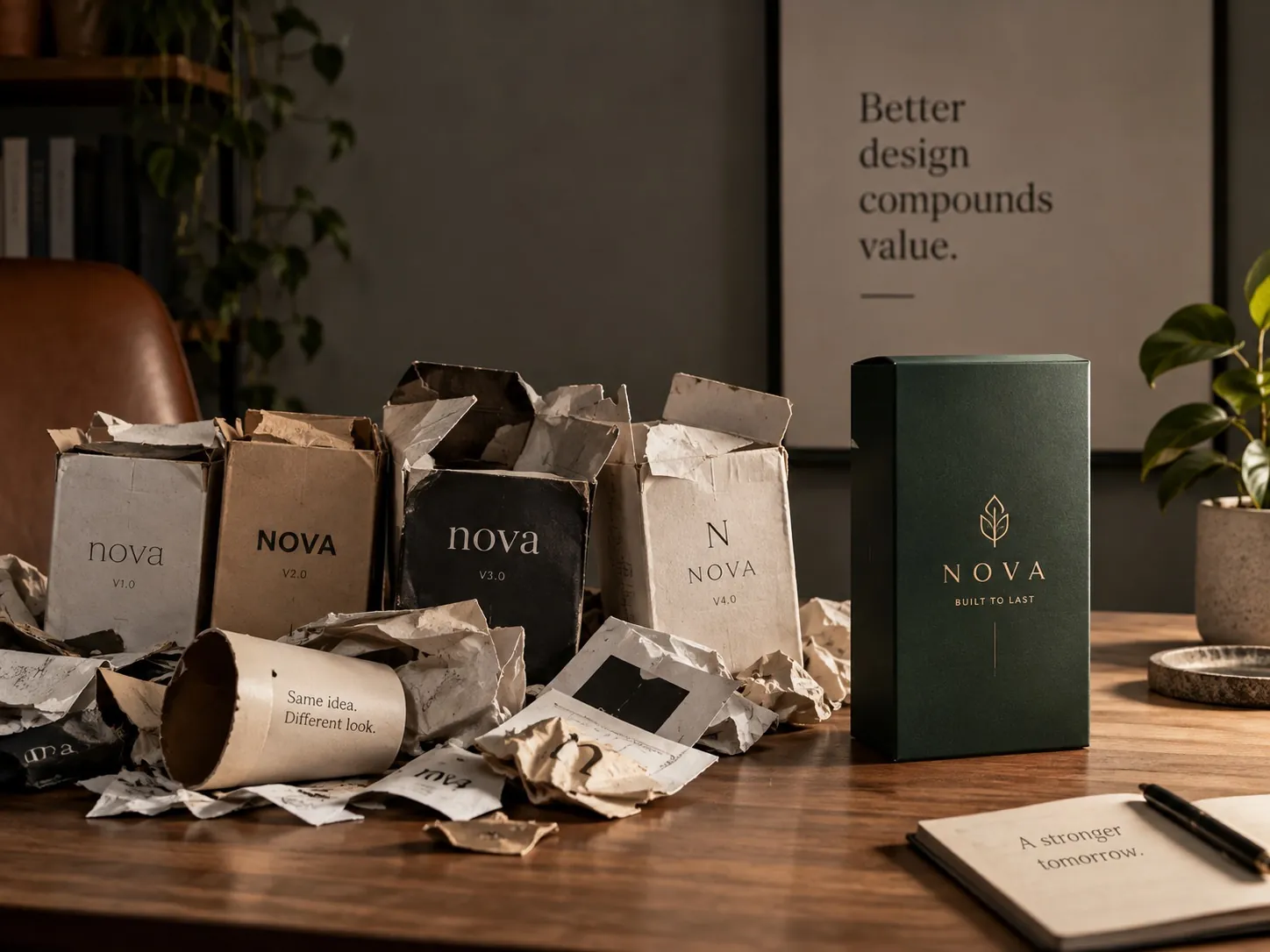
The Most Expensive Design Is the One You Keep Replacing
A cheap solution becomes expensive when the business has to rebuild it every time the company grows.

Why is repeatedly replacing design more expensive than investing properly once?
Design cost is easy to compare when it appears as a project fee. Long term cost is harder to see. A low priced identity may look efficient until the company has to replace it two years later, rebuild the website, redo packaging and retrain everyone using the old system. The expensive part is rarely the logo file. It is implementation and lost continuity. Each reset spends production budget, resets some of the recognition customers had started to build, and adds months of looking inconsistent while the change rolls through every asset the company owns.
Two numbers, only one of them visible
When a business compares design proposals, it compares fees. That is the only number available at the moment of the decision, so it becomes the whole decision. One quote is four thousand dollars, another is twenty, and the gap looks like a simple question about how much a company wants to spend on graphics.
The number that never appears on either proposal is the total cost of ownership. How long will this identity remain usable. How many assets will have to be produced from it. What happens when a fourth product is added, or a second audience, or a retail channel that did not exist when the work was made. Nobody quotes that, because nobody can quote that, so it gets left out of the comparison entirely.
I am not making the lazy argument that expensive design is better design. It often is not. What I am saying is that the fee is the smallest number in the sequence, and choosing on the fee alone means choosing on the least informative figure available. The businesses I have watched spend the most on design over a decade are almost never the ones that spent the most on any single project.
The logo file is the cheap part
Here is where the money actually goes, and it is worth walking through the sequence slowly because it is the part nobody models in advance. Say a company replaces its identity in year three. The design fee is whatever it is, and it is paid early, which is why it dominates everyone’s memory of the project. Then the real bill arrives in pieces over the following months.
Every package has to be rebuilt, and each one means new artwork, new proofing, new plates or new digital setup, and a print minimum. Existing inventory of cartons, labels and shippers becomes either scrap or a year of mixed presentation on the shelf. The website needs new headers, new templates, new product photography if the packaging appears in it. Sales collateral is redone. Signage comes down and goes up. Vehicles are rewrapped. Uniforms are reordered. Trade show property is replaced. Marketplace listings and their image sets are rebuilt one at a time, by hand.
Then there is the labor nobody forecasts: the coordination. Someone has to chase every vendor, approve every proof, track which assets have been converted and which have not, and answer questions from people who have found an old file. That work is real, it lands on an operations person who already had a job, and it stretches across months.
Against that list, the difference between two design fees is noise. This is the mechanism behind what I mean when I say that every brand has a cost and the best ones become assets. The cost is never the drawing. It is the deployment.
Work built for today breaks tomorrow
The reason cheap identities get replaced so quickly is rarely that they were ugly. Plenty of them were perfectly attractive on the day they were delivered. They get replaced because they were built to answer one immediate question and nothing else, and a business does not stay still long enough for one question to remain the only question.
A typical version goes like this. A founder needs a logo to launch one product. She gets a mark that looks good on that one box. It works. Then the second flavor arrives and there is no rule for how variants differentiate, so a color gets chosen on the spot. Then a third and a fourth, each one another improvised decision. By the sixth product the line does not look like a line, it looks like six companies that happen to share a name. A retail buyer sees a shelf set with no family logic and reads it as an amateur operation, correctly.
The same thing happens across channels rather than products. An identity designed for print discovers that its type disappears at thumbnail size on a marketplace listing. A mark drawn for a website turns out to be unreadable on a vehicle at forty miles per hour. A palette that looked refined on screen cannot be matched in a single hit of flexo printing on kraft.
None of that is a failure of taste. It is a failure of scope. The work never anticipated expansion because expansion was not in the brief, and the company pays a second time to buy what it needed the first time. That is the case for treating brand expansion as something you design for, not something you react to.
Every reset spends recognition
Production cost is the part companies eventually see, because invoices arrive and someone has to sign them. The part they almost never account for is continuity, and continuity is where the larger loss usually sits. It never generates a document, so it is never discussed in the meeting where the decision is made.
Recognition accumulates slowly. A customer sees the package, then sees it again six weeks later, then recognizes it on a shelf without reading the name. A buyer starts to associate the color with the category. That process takes years, and it is the entire reason established brands can spend less per sale than new ones.
A redesign interrupts it. Customers have to reconnect the new presentation to the company they already knew, and some of them simply do not. The repeat buyer who looked for the yellow pouch does not find it. The regular who recognized the van drives past. Necessary change is worth that cost. My objection is to unnecessary change, and specifically to repeated unnecessary change, because a company that resets every two years never lets the account accumulate at all. It is always paying the cost of being new.
Companies do not usually choose this. They arrive at it, one forced replacement at a time, because the previous system could not stretch. That is the difference between a company that outgrew its brand and one that never had a brand built to grow, and I have written about companies outgrowing their brands as a distinct and healthier problem.
Inconsistency is a permanent labor cost
Between replacements, a weak system charges rent. This is the cost I find hardest to convince people of, because it is invisible in any budget line and enormous in aggregate. It does not arrive as a bill. It arrives as time, spread so thinly across so many people that no single instance looks like it is worth measuring.
A system without rules requires a judgment call every time anyone touches it. Which logo file is current. Is this the right blue, or the one the printer approximated in 2021. What typeface do we use for a spec sheet. How big should the claim be. Where does the icon go on a square format. Each question is small. Each one interrupts someone, gets answered inconsistently, and produces an asset that is slightly different from the last one.
Multiply that by every employee, every freelancer, every printer, every marketplace, every month. The marketing coordinator recreates a layout because she cannot find the file. An agency rebuilds a template from a screenshot. Two sell sheets go out with different colors and nobody notices until a customer does. The company is paying, in salary, to re decide things a system should have decided once.
What actually makes a system durable
Durability is not a matter of picking timeless styling, and I am suspicious of anyone who sells it that way. Nothing is immune to fashion, and trying to be usually produces work with no character at all. Durability comes from somewhere less romantic: the parts of the job that never appear in a portfolio because they are impossible to photograph.
It comes from a type hierarchy that tells anyone how a headline, a claim, a variant name and a legal block relate to each other, so a new piece can be built without inventing that relationship. It comes from a color structure with a defined role for each color rather than a row of swatches. It comes from spacing logic that holds at different sizes.
It also comes from a stated rule for how a new product joins a family, which is the single most valuable thing a growing product company can own and the thing most often missing. And it comes from knowing what the mark does at a fingernail size and at a hundred feet, with a version built for each rather than one drawing scaled and hoped for.
None of that is glamorous and none of it presents well. It is also the entire difference between an identity that lasts eight years and one that lasts two, which is the practical case for building a brand system instead of just a logo.
Durable does not mean frozen
I should be clear about what I am not arguing, because permanence is its own expensive mistake and it is the one companies make after being burned by too many resets. Overcorrecting into rigidity costs just as much as churn does, it just takes longer to show up and it is harder to reverse once the culture has settled around it.
The goal is not to predict every future need. Nobody can. Markets shift, channels appear, a company decides to enter a category it had not considered. The goal is not to freeze the brand either. An identity that cannot be refreshed becomes a museum piece, and companies that treat their guidelines as scripture end up looking dated for years because nobody is allowed to touch anything.
What a durable system gives you is the ability to absorb change through extension rather than replacement. A new product line joins the family by following the existing rules. A new channel is served by an application the system already anticipated. A refresh updates typography and photography while the recognizable core stays put, so customers experience continuity while the work gets better.
How to buy fewer resets
The buying process itself determines most of this, and almost all of it happens before any designer is chosen. By the time the work begins, the brief has already decided whether the result can grow. Clients tend to believe the outcome depends on who they hire, and it does, but it depends at least as much on what they asked for.
Write a brief that describes the business in three years, not just the deliverable today. How many products. Which channels. Which customers. Whether there will be retail, and whether there will be international. A designer who knows a fourth and fifth product are coming will build a variant system. A designer who is told about one box will build one box, and that is a reasonable thing to do with the information given.
Ask what you are receiving beyond files. Ask specifically: what rules come with this, what happens when we add a product, what formats do we get, how does this behave at small sizes. The answers separate people who are selling a picture from people who are selling a system. Both are legitimate purchases, but you should know which one you are making.
Then judge proposals on years of usable life rather than on the fee. Strategic work usually costs more upfront because it is solving a larger problem, and the return arrives later, as consistency, as recognition that accumulates, as rework that never happens. The most economical identity is almost always the one strong enough to stay useful while the business changes around it.
What to look at this week
Open your brand folder and look for the last time something drifted. Compare your three most recent pieces of collateral against the oldest one still in circulation. Count the differences in color, typeface and logo version. Every difference you find is a place where someone had to guess, and guessing is the cost showing itself.
Next, ask your team the file question. Send one message: where is the current logo, and which blue is correct. Time the responses and count the different answers. If more than one version comes back, or if the answer is a link to a slide deck, you do not have a system. You have a folder, and folders decay.
Then count your last three years of design spend honestly. Not the fees alone. Add print reruns caused by artwork changes, the collateral rebuilt because there was no template, the hours someone spent recreating assets, the inventory written off after a change. Most companies are surprised by the total, and it is the only figure that makes the real comparison possible.
Finally, decide what your next product launch requires. If adding a SKU means a fresh design conversation every time rather than following a rule, that is the gap to fix first, and it is cheaper to fix before the launch than after. If you are unsure whether you need a rebuild or just the missing rules written down, that is a short conversation rather than a long project, and it frequently ends with less work than people expect.
Key points
- Brand perception changes the amount of friction a company faces in sales and growth, and repeated resets keep that friction high.
- The design fee is the smallest number in a rebrand, because implementation, inventory and coordination carry most of the cost.
- Identities built for one immediate need break as soon as a second product, channel or audience appears.
- Every unnecessary redesign spends recognition that took years to accumulate, so the company keeps paying to be new.
- A system without rules charges a permanent labor cost in recreated files, mismatched assets and repeated judgment calls.
- Durable does not mean frozen: a good system absorbs growth through extension instead of replacement.